
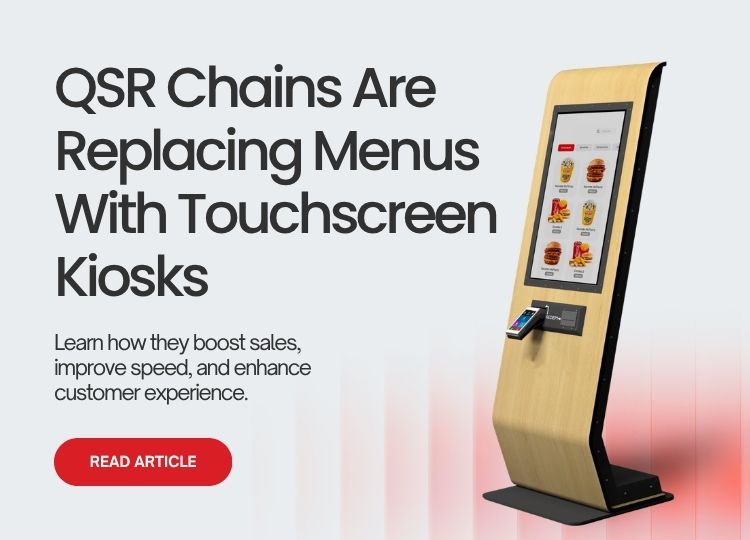
India’s quick-service restaurant (QSR) industry is undergoing a visible shift. Walk into any modern outlet today, and instead of scanning a printed menu or waiting in line to order, you’re more likely to interact with a sleek touchscreen kiosk.
This isn’t just a design upgrade—it’s a strategic move driven by cost efficiency, customer behavior, and the need for speed at scale.
The Shift: From Static Menus to Interactive Ordering
Traditional menu boards and counter-based ordering are being replaced by self-service kiosks that allow customers to browse, customize, and pay—without staff intervention.
For QSR brands operating in high-footfall environments like malls, airports, and high streets, this change is becoming essential rather than optional.
1. Faster Service = Higher Throughput
In busy outlets, long queues directly impact revenue. Touchscreen kiosks reduce bottlenecks by:
- Allowing multiple customers to order simultaneously
- Eliminating back-and-forth with staff
- Reducing ordering errors
Result: More orders processed per hour, especially during peak times.
For high-volume chains, even a 10–15% increase in throughput can significantly boost daily sales.
2. Higher Average Order Value (AOV)
Kiosks are designed to upsell—consistently and without hesitation.
They can:
- Suggest combos automatically
- Highlight add-ons like fries, drinks, or desserts
- Use visual prompts to influence decisions
Unlike human staff, kiosks never forget to upsell.
Impact: Studies globally show kiosk orders often have a higher ticket size compared to counter orders.
3. Reduced Dependency on Staff
Staffing is one of the biggest operational challenges for QSR chains in India:
- High attrition rates
- Training costs
- Inconsistent service quality
Touchscreen kiosks help reduce reliance on front-counter staff while maintaining service efficiency.
Staff can instead focus on:
- Food preparation
- Customer assistance
- Faster delivery
This leads to better resource allocation without compromising experience.
4. Improved Order Accuracy
Miscommunication at the counter is common—especially in noisy environments or with complex orders.
Kiosks eliminate this by allowing customers to:
- Select exact items and customizations
- Review the order before payment
Outcome: Fewer errors, fewer refunds, and smoother kitchen operations.
5. Enhanced Customer Experience
Today’s consumers—especially Gen Z and millennials—prefer speed, control, and minimal friction.
Touchscreen kiosks offer:
- Visual menus with images and videos
- Easy customization (extra cheese, no onion, etc.)
- Multiple payment options (UPI, cards, wallets)
For many customers, it feels faster, more intuitive, and less stressful than ordering at a counter.
6. Data-Driven Decision Making
Unlike static menus, kiosks generate valuable data:
- Popular items
- Peak ordering times
- Customer preferences
- Conversion rates on upsells
QSR brands can use this data to:
- Optimize menu design
- Introduce new items
- Improve pricing strategies
This turns every order into a data point for smarter business decisions.
7. Easy Menu Updates and Promotions
With printed menus or static boards, updates are slow and costly.
With kiosks:
- Prices can be updated instantly
- New items can be added in minutes
- Promotions can be scheduled dynamically
For example:
- Lunch combos during the day
- Dessert promotions in the evening
This flexibility allows brands to maximize revenue opportunities throughout the day.
8. Hygiene and Contactless Preference
Post-pandemic, customer preferences have shifted toward minimal contact interactions.
Kiosks support:
- Self-ordering without close human interaction
- Digital payments
- Cleaner, more controlled touchpoints
Some advanced systems even integrate QR-based ordering for fully contactless experiences.
9. Consistent Brand Experience Across Locations
For chains expanding across Tier-1 and Tier-2 cities, consistency is key.
Touchscreen kiosks ensure:
- Same menu layout everywhere
- Same upsell prompts
- Same pricing and offers
This creates a uniform customer experience regardless of location.
10. Long-Term Cost Efficiency
While the initial investment in kiosks may seem high, the long-term ROI is strong due to:
- Lower staffing costs
- Increased order value
- Higher operational efficiency
Most QSR brands recover their investment within a relatively short time frame.
Challenges to Consider
The transition isn’t without challenges:
- Initial setup cost
- Maintenance and downtime risks
- Customer adaptation in smaller cities
However, with proper implementation and support, these challenges are manageable—and often temporary.
The Future of QSR Ordering in India
Touchscreen kiosks are not a trend—they’re becoming the new standard.
As competition increases and customer expectations evolve, QSR brands that prioritize speed, personalization, and efficiency will lead the market.
In the coming years, expect further innovations such as:
- AI-driven recommendations
- Voice-enabled ordering
- Integration with loyalty programs
- Seamless omnichannel experiences
Conclusion
Indian QSR chains are replacing traditional menus with touchscreen kiosks because it makes business sense.
They deliver:
- Faster service
- Higher revenue per order
- Better customer experience
- Smarter operations
For brands aiming to scale efficiently in a competitive market, kiosks are no longer a luxury—they’re a necessity.