Picture this. A couple walks into a large furniture showroom. Within ten minutes, one of them is tired and ready to leave. The other wants to keep browsing. If there is nowhere to sit, they both leave, and the sale walks out with them.
Now picture the same showroom with a few well-placed seating areas. One person rests while the other browses. The time spent in the store doubles. The likelihood of a purchase increases significantly.
This is not a hypothetical. Retail research consistently shows that comfort directly influences how long people stay in a store, how they feel about the brand, and whether they come back. Soft seating is one of the most underestimated tools in a retail designer’s arsenal — and one of the highest-return investments a store operator can make.
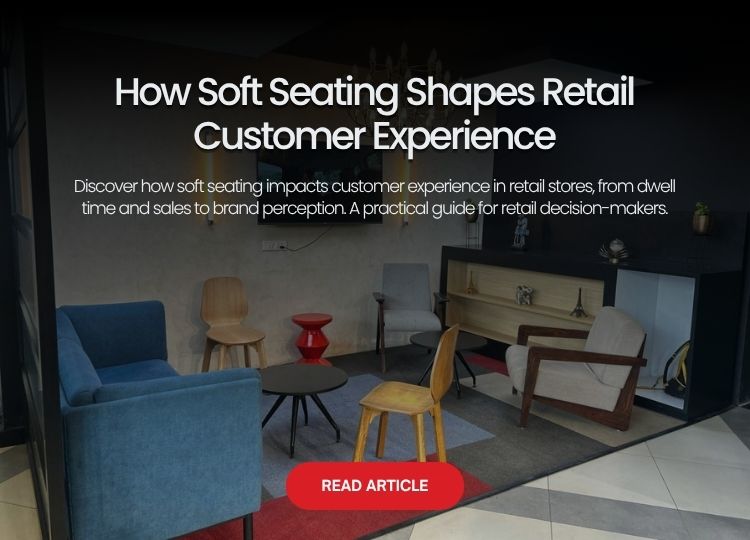
This guide explores how soft seating impacts customer experience in retail stores, why it matters more than most retailers realise, and how to use it strategically.
What Is Soft Seating in a Retail Context?
Soft seating refers to any upholstered or cushioned seating designed for comfort and aesthetic appeal rather than pure utility. In a retail environment, this includes lounge chairs, sofas, ottomans, benches with cushioned tops, accent chairs, and modular seating units.
It is distinct from hard seating — plain wooden benches, metal chairs, or fixed stools — which prioritise throughput and durability but offer very little in terms of comfort or brand experience.
Soft seating in retail is not about giving people a place to rest their feet. It is a deliberate design decision that communicates brand values, shapes the pace of a visit, and directly influences how customers feel while they are in your space.
The Connection Between Comfort and Dwell Time
Dwell time, the amount of time a customer spends inside a store — is one of the most reliable predictors of conversion. The longer a customer stays, the more they see, the more they engage with products, and the more likely they are to buy.
Fatigue is the silent enemy of dwell time. Customers who are physically tired become mentally disengaged. They stop noticing new products, stop asking questions, and start thinking about the exit. This happens faster than most retailers realise — research from the retail and environment design space suggests that shopping fatigue can set in within 20 to 30 minutes of entry in a busy store.
Soft seating interrupts this pattern. A brief rest of even five to ten minutes resets a customer’s physical comfort and mental focus. They re-engage with the environment. In large-format stores — furniture showrooms, electronics stores, clothing boutiques, luxury retail — this effect is especially pronounced because the product range is wide and the purchase decision often involves multiple considerations.
Brands that have invested in comfortable seating areas in their stores consistently report longer average visit times. And longer visits correlate strongly with higher basket values.
How Soft Seating Shapes Brand Perception
Every element of a store’s physical environment sends a signal about the brand. The lighting, the floor material, the display fixtures, the scent, the music — all of it contributes to how a customer feels and what they associate with the brand.
Soft seating is one of the most powerful of these signals because it communicates something specific: the brand values your time and your comfort. That is not a small message. In a competitive retail landscape where customers have countless alternatives, being the store that made someone feel genuinely welcome creates a memory that drives return visits and word-of-mouth.
Consider the contrast. A store with hard, minimal seating — or none at all — communicates efficiency and throughput. It is the retail equivalent of a fast food experience. A store with considered, high-quality soft seating communicates that you are invited to take your time, explore, and enjoy the space. These two experiences create entirely different brand associations, even if the products being sold are identical.
Luxury brands understand this deeply. Walk into a Burberry store, a premium watch retailer, or a high-end home furnishings brand, and the first thing you notice after the product display is the quality of the seating. That seating is not there by accident. It is a brand statement made in fabric and foam.
Soft Seating as a Conversion Driver: The Data Behind It
The retail industry has generated a substantial body of evidence connecting physical comfort to purchasing behaviour. A few key insights are worth understanding.
Customers in a positive physical state make more favourable evaluations. When customers are comfortable — not tired, not rushed, not physically strained — their emotional state is more positive. Positive emotional states are strongly associated with more optimistic product evaluation, greater willingness to spend, and higher tolerance for premium pricing.
Companions and accompanying shoppers are a powerful variable. A very large proportion of retail purchases involve at least two people — a shopper and a companion who is not actively shopping. If the companion has nowhere comfortable to sit, they become a pressure to leave. If they are seated comfortably — even better, near a product display or interactive screen — they become a passive advocate for staying longer and spending more.
Post-purchase comfort increases satisfaction scores. Customers who were physically comfortable during their shopping experience rate the overall experience more highly, even when other variables are held constant. This has direct implications for NPS scores, online reviews, and return visit rates.
Where to Place Soft Seating in a Retail Store
Strategic placement is what separates seating that drives results from seating that simply occupies floor space. Here are the locations that deliver the most commercial value.
Near high-consideration product areas. Anywhere a customer is making a complex or high-value decision — a fitting room lobby, a product demonstration zone, a custom order counter — soft seating reduces the pressure of decision-making. When someone is physically relaxed, they think more clearly and are less likely to default to walking away.
At natural rest points in the customer journey. In a large store, there are natural points where the browsing pace slows — typically after 15 to 20 minutes of active engagement. Placing seating near these points catches customers before fatigue drives them to the exit.
Companion zones near active shopping areas. Children’s sections, men’s sections in women’s-led stores, technology trial areas — these are places where one person is actively engaged and another is waiting. A comfortable seating area in these zones is not just considerate; it is commercially strategic. A comfortable companion is not pushing to leave.
At store entrances and transition zones. Entry-level seating creates a psychological decompression moment — a signal that this is a space to slow down and engage, not rush through. It sets the pace for the entire visit.
In fitting room and changing areas. This is perhaps the highest-impact location in apparel retail. The fitting room experience is where the purchase decision is made or broken. A well-designed seating area outside fitting rooms — for companions and for customers making decisions — directly influences conversion at the most critical point in the journey.
Soft Seating Design: Matching the Brand Aesthetic
Choosing the right soft seating is not purely about comfort. The design, material, colour, and scale of the seating must align with the store’s overall brand identity.
A minimalist fashion brand will typically favour clean-lined chairs or benches in neutral tones — linen, concrete-grey upholstery, natural oak frames. A children’s toy store might choose low, rounded, brightly coloured seating that connects with the child and not just the parent. A luxury jewellery brand might opt for velvet-upholstered accent chairs in deep jewel tones that reinforce the richness of the products being presented.
The material choice also affects the message. Leather seating suggests permanence and premium quality. Fabric in natural tones communicates warmth and approachability. Modular seating in bold colours suggests creativity and energy. Mismatched or worn upholstery — regardless of original quality — communicates neglect and undermines the entire brand environment.
The scale of the seating matters too. Oversized, deeply upholstered sofas work in a home furnishings showroom but would dominate and obstruct a compact multi-brand boutique. The seating should feel proportional to the space and to the product experience.
The Role of Soft Seating in Different Retail Formats
The application of soft seating varies meaningfully across different types of retail stores.
Fashion and Apparel Retail: Companion seating near fitting rooms is the highest-priority investment. Floor-plan permitting, lounge zones in the main browsing area extend dwell time and create a lifestyle association with the brand.
Furniture and Home Furnishings: In these environments, the seating is often also the product. Showrooms need to allow customers to genuinely experience the furniture — to sit in it, feel the materials, and imagine it in their home. Soft seating here serves a dual purpose: functional rest and product demonstration.
Electronics and Technology Retail: Trial and demonstration zones benefit enormously from comfortable seating. A customer sitting comfortably while testing a laptop, gaming device, or home cinema system is more likely to engage deeply and spend longer with the product. A customer standing in an awkward position while a salesperson demonstrates a product is distracted by physical discomfort.
Luxury and Premium Retail: In this segment, the quality of every physical touchpoint defines the brand experience. Soft seating is not optional — it is essential. The product is often positioned as a statement of considered living, and the physical environment of the store must reinforce that message at every point.
Beauty and Wellness Retail: Consultation-led formats — where customers discuss skin concerns, fragrance preferences, or wellness goals with a specialist — benefit from seating that facilitates a relaxed, conversational dynamic. A standing consultation feels transactional. A seated consultation feels personal.
Common Mistakes Retailers Make with In-Store Seating
Even retailers who invest in seating often undermine its impact through poor execution. Here are the most common errors.
Choosing seating that prioritises aesthetics over comfort. A visually stunning chair that is physically uncomfortable defeats the purpose entirely. Customers will sit briefly, find it uncomfortable, and leave faster than they would have without any seating.
Placing seating too far from the customer journey. Seating tucked in a corner or placed away from the main shopping flow is easy to miss and easy to ignore. It needs to be visible and accessible from within the natural browsing path.
Under-investing in maintenance. Worn, stained, or damaged seating is worse than no seating. It actively communicates neglect and creates a negative emotional response. Soft seating requires a maintenance plan — regular cleaning, upholstery inspection, and periodic replacement.
Ignoring companion shoppers entirely. Many retailers design for the primary shopper and forget the companion. This is a significant commercial oversight. A well-designed companion zone near high-engagement areas is one of the simplest ways to increase average visit time and conversion.
Using domestic-grade furniture in a commercial setting. Retail environments subject furniture to far greater daily use than a home. Domestic-grade soft seating deteriorates quickly in a commercial setting, leading to premature wear and replacement costs that exceed what a commercial-grade product would have cost upfront.
Integrating Soft Seating with Digital Signage
One of the most effective strategies in modern retail design is pairing soft seating zones with digital displays. A customer who is comfortably seated and passively absorbing content on a well-positioned digital screen is in an ideal state for brand communication — relaxed, attentive, and not rushing.
This approach works particularly well in companion zones, product waiting areas, and consultation spaces. A 43-inch or 55-inch display running brand content, product demonstrations, or promotional offers alongside a seating zone creates a micro-environment that is both comfortable and commercially active.
The combination of physical comfort and dynamic visual content is one of the most powerful tools available to retail designers in 2026. Customers in these zones typically spend longer in the immediate area and show higher engagement with the content being displayed.
Want to create a retail environment that keeps customers longer and converts better?
VVT Communications designs and installs complete retail solutions — from custom digital displays and interactive kiosks to bespoke seating zones and retail fixtures — all under one roof.
Reach out for a consultation at vvtdigital.com.
FAQ: Soft Seating and Customer Experience in Retail
Q1. Does soft seating in a retail store actually increase sales?
Yes, indirectly but meaningfully. Soft seating increases dwell time, and longer dwell time is one of the strongest predictors of higher conversion and larger basket values. It also reduces companion-driven pressure to leave, which is one of the most common reasons for shortened store visits.
Q2. How much floor space should a retail store dedicate to seating?
There is no universal answer — it depends on store size, format, and customer journey. As a general principle, seating should be present near any high-consideration product zone, fitting room area, or companion waiting point. In a 1,000 sq ft boutique, even one or two well-placed accent chairs can have a meaningful impact. In a 5,000 sq ft showroom, multiple seating zones are appropriate.
Q3. What type of soft seating works best in a retail environment?
Commercial-grade upholstered seating in a material and style that aligns with the brand aesthetic. The seating must be comfortable enough for at least 15 to 20 minutes of use, durable enough for daily commercial traffic, and proportional to the space. Avoid domestic-grade furniture, which deteriorates quickly in commercial settings.
Q4. Is soft seating relevant only for large retail stores?
No. Even in compact retail formats, a single well-placed seating option can extend visit time, improve companion comfort, and communicate brand care. The scale should match the space, but the principle applies across store sizes.
Q5. How does seating interact with digital signage in a retail store?
Pairing seating zones with digital displays creates a highly effective micro-environment. A seated customer passively viewing a well-positioned digital screen is in an ideal state for brand communication — relaxed, attentive, and receptive. This combination is particularly effective in companion zones, product waiting areas, and consultation spaces.
Conclusion
Soft seating is not a decorative afterthought. In a well-designed retail environment, it is a strategic asset that directly influences how long customers stay, how they feel about the brand, and whether they come back.
The retailers who understand this — who invest in quality, well-placed, brand-appropriate seating — consistently outperform those who treat customer comfort as a secondary consideration. In an era where physical retail must offer something that online shopping cannot, the felt experience of being in a store matters more than ever.
Comfort is an experience. And experience is what keeps customers coming back.
Building or redesigning a retail space?
VVT Communications has been transforming retail environments for over 30 years, combining custom retail fixtures, modular furniture, and digital signage solutions to create spaces that engage, retain, and convert.
Get in touch at vvtdigital.com or call +91-98100 22287.