
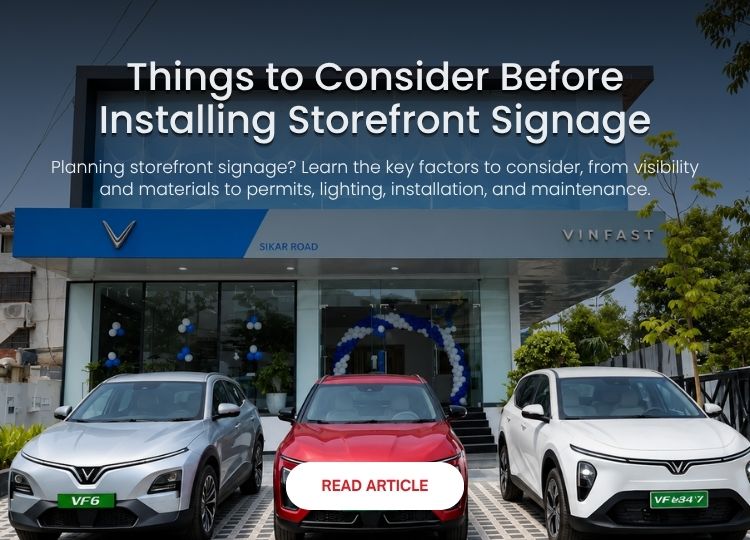
Your storefront is often the first physical interaction customers have with your brand. Before they enter the store, they notice the building, entrance, display windows, branding and, most importantly, the storefront signage.
A well-planned storefront sign can make your store easier to find, strengthen brand visibility and create a consistent retail identity. However, installing a sign is not simply about choosing a logo, material or attractive lighting. Several practical factors need to be considered before fabrication and installation begin.
The location of the store, viewing distance, sign size, mounting surface, lighting, local regulations, weather conditions and overall brand guidelines can all affect the final result. Poor planning can lead to visibility issues, installation challenges, higher costs and frequent maintenance.
Therefore, businesses should evaluate the complete signage requirement before moving into production.
In this guide, we discuss the most important things to consider before installing storefront signage, helping retail owners, managers and project teams make informed decisions.
Why Storefront Signage Matters for Retail Stores
Storefront signage does more than display a brand name.
It helps customers identify a store, understand where the entrance is and recognize the brand from a distance. In busy retail environments, effective signage can also help a store stand out among neighbouring businesses.
For multi-location brands, consistent signage plays an important role in maintaining the same visual identity across different cities and store formats.
Good storefront signage should therefore balance three things:
- Visibility
- Brand identity
- Practical functionality
A sign may look excellent in a design file but fail when installed if its size, viewing angle or lighting has not been considered properly.
That is why signage planning should happen before fabrication begins.
1. Understand the Store Location
The first thing to consider before installing storefront signage is the location of the store.
A sign installed inside a shopping mall will have very different requirements from one installed on a busy roadside retail outlet.
Consider the surrounding environment carefully.
Storefront Location
Ask where customers will see the sign from:
- A main road
- A parking area
- A pedestrian walkway
- A shopping mall corridor
- A high street
- A commercial building
- A residential neighbourhood
The viewing environment determines the appropriate sign size, mounting position and lighting requirements.
For example, a roadside store may require signage that remains visible from a greater distance. A mall store may need a more compact sign because customers view it primarily while walking through the corridor.
Surrounding Buildings
Look at nearby buildings and businesses.
If several stores use large illuminated signs, a small non-illuminated sign may struggle to attract attention. On the other hand, if the surrounding environment is visually simple, excessive signage may not be necessary.
The goal is to achieve clear visibility without creating unnecessary visual clutter.
2. Check Local Signage Regulations
Before starting fabrication, check whether the location has specific signage regulations.
Depending on the city, building, mall or commercial complex, there may be rules regarding:
- Sign dimensions
- Projection from the building
- Installation height
- Illumination
- Electrical connections
- Sign placement
- Structural fixing
- Permitted materials
- Operating hours for illuminated signage
Shopping malls and commercial properties may also have their own brand and signage guidelines.
Getting approval after fabrication can create unnecessary delays. Therefore, it is better to confirm the requirements during the planning stage.
Get Approvals Before Production
If approval is required, prepare the necessary drawings, dimensions and specifications before sending the signage for manufacturing.
This simple step can prevent costly modifications later.
3. Choose the Right Signage Type
There are several types of storefront signage available. The right choice depends on the brand, location, budget and desired visual effect.
Common options include:
Channel Letters
Channel letters are individual three-dimensional letters mounted directly onto a façade or backing structure.
They can be illuminated from the front, back or both, depending on the design.
They work particularly well for brands that want strong visibility while maintaining a clean appearance.
LED Signage
LED illumination can improve visibility during evening hours and low-light conditions.
LED-based signage can be used with different sign formats, including channel letters, light boxes and fabricated signage.
Light Boxes
Light boxes use an illuminated internal structure with a printed or translucent face.
They can provide uniform branding across larger areas and work well for retail environments where strong visual communication is required.
3D Letters
Non-illuminated 3D letters can provide a premium appearance without requiring internal lighting.
Materials such as acrylic, metal and PVC can be used depending on the desired finish.
Pylon and Freestanding Signs
For standalone retail locations, pylon or freestanding signage can help improve visibility from roads and parking areas.
The right format depends on the available space and local regulations.
4. Consider Visibility From Different Distances
One of the biggest mistakes businesses make is designing a sign only from a close-up perspective.
A storefront sign needs to work from the distance at which customers actually see it.
Think about the customer journey.
A person driving past the store may see the sign from 50–100 metres away. A pedestrian might see it from 20 metres away. Someone standing directly outside the store may view it from just a few metres.
Each viewing distance creates different requirements.
Consider:
- Letter height
- Font thickness
- Contrast
- Spacing
- Logo proportions
- Lighting
- Background colour
- Viewing angle
The sign should remain readable without customers having to stop and concentrate on it.
5. Get the Sign Size Right
Bigger does not always mean better.
An oversized sign can look out of proportion with the building façade. At the same time, a sign that is too small may become difficult to notice.
The correct size depends on:
- Building dimensions
- Façade width
- Viewing distance
- Brand guidelines
- Surrounding signage
- Installation location
- Local restrictions
Before fabrication, create a proper elevation or mock-up showing how the proposed signage will look on the actual storefront.
This gives the project team a much better understanding of scale.
6. Select Materials Based on the Environment
Material selection plays a major role in signage durability.
A sign installed indoors does not face the same conditions as signage installed outdoors.
Outdoor signage may experience:
- Rain
- Dust
- Heat
- Humidity
- Sunlight
- Wind
- Temperature changes
Therefore, materials should be selected according to the installation environment.
Common Signage Materials
Depending on the application, signage may use:
- Acrylic
- Aluminium
- Stainless steel
- Mild steel
- PVC
- ACP
- Polycarbonate
- Vinyl
- LED modules
- Translucent films
Each material offers different benefits in terms of appearance, durability, weight, fabrication and maintenance.
The cheapest material may not always be the most economical option in the long run.
7. Think About Weather and Durability
For outdoor storefront signage, weather resistance should be part of the planning process.
A sign may look perfect immediately after installation but experience problems later if the materials and electrical components are not suitable for the environment.
For outdoor installations, consider:
- Water resistance
- Corrosion protection
- UV exposure
- Paint or coating quality
- Electrical protection
- Drainage
- Structural strength
- Mounting hardware
If the store operates in a location with heavy rainfall or high humidity, additional attention should be given to waterproofing and corrosion protection.
A durable signage solution reduces the need for frequent repairs and replacements.
8. Plan the Lighting Carefully
Lighting can significantly change how storefront signage appears.
For businesses operating after sunset, illuminated signage can help maintain visibility throughout the evening.
However, lighting should be planned carefully.
Common Lighting Options
Depending on the sign type, businesses can consider:
- Front illumination
- Back illumination
- Halo lighting
- Edge illumination
- Internal LED lighting
- External spotlights
The lighting should support readability rather than overpower the branding.
Uniform illumination is particularly important. Dark patches, hotspots or inconsistent brightness can make even a well-designed sign look unfinished.
9. Consider Energy Efficiency
If the signage remains illuminated for several hours every day, energy consumption should also be considered.
Modern LED systems can provide strong illumination while using relatively low power compared with older lighting technologies.
During planning, discuss:
- LED quality
- Power consumption
- Operating hours
- Driver accessibility
- Electrical load
- Replacement requirements
Energy-efficient signage can help reduce operating costs over the lifespan of the installation.
10. Check the Building Structure
Before installation, confirm whether the existing façade can support the proposed signage.
This becomes especially important for larger signs, metal structures, projecting signs and heavy fabricated elements.
The installation team should understand:
- Wall construction
- Mounting points
- Sign weight
- Fixing method
- Wind load considerations
- Access requirements
A visually impressive sign is not useful if the installation method is not safe or suitable for the building.
For larger projects, structural considerations should be reviewed before fabrication.
11. Plan Electrical Requirements
Illuminated signage requires proper electrical planning.
Before installation, determine where the power supply will come from and how the signage will be connected.
Consider:
- Power source
- Cable routing
- Electrical load
- LED drivers
- Switch location
- Timer or control system
- Access for maintenance
Electrical components should remain accessible for future servicing without requiring the entire sign to be removed.
This is particularly important for stores that operate long hours.
12. Maintain Brand Consistency
For retail chains, signage should follow established brand guidelines.
This includes consistency in:
- Logo proportions
- Colours
- Typography
- Letter spacing
- Illumination
- Materials
- Finishes
- Sign dimensions
Customers should be able to recognize the same brand whether they visit a store in Mumbai, Delhi, Bengaluru or another city.
However, standardization should not mean ignoring the individual site.
The signage may need to be adapted to different building façades while maintaining the core brand identity.
13. Think About the Entrance and Overall Storefront
Storefront signage should not be planned in isolation.
Look at the complete storefront.
The relationship between the signage, entrance, glass façade, display windows, branding panels and other retail fixtures should feel intentional.
For example, if the storefront has:
- Large signage
- Window graphics
- Promotional graphics
- Entrance branding
- Digital displays
- Directional signs
all these elements should work together rather than compete for attention.
A coordinated storefront creates a stronger retail presence.
14. Consider Maintenance Before Installation
Maintenance is often overlooked during signage planning.
Ask an important question before installation:
“How will we maintain this sign after it is installed?”
For illuminated signage, LEDs and electrical components may eventually require servicing.
If the sign is installed at a significant height, maintenance may also require special equipment.
Consider:
- Accessibility
- Cleaning requirements
- LED replacement
- Electrical servicing
- Paint touch-ups
- Panel replacement
- Installation of access points
Planning maintenance early can save time and money later.
15. Think About Installation Access
A signage project can face unexpected delays if installation access is not planned.
Before manufacturing, check:
- Can the installation team access the storefront?
- Is a ladder sufficient?
- Is scaffolding required?
- Is a boom lift required?
- Are there mall working-hour restrictions?
- Is a road permit required?
- Can vehicles reach the site?
- Is there enough space for unloading?
These factors are especially important for large retail projects involving multiple locations.
The signage manufacturer and installation team should coordinate with the site team before dispatch.
16. Consider Budget Beyond Fabrication
Your signage budget should include more than the cost of manufacturing.
Additional costs may include:
- Site survey
- Design adaptation
- Structural support
- Electrical work
- Transportation
- Installation
- Lifting equipment
- Permits
- Maintenance
- Repairs
Getting a complete quotation helps avoid surprises later.
Instead of comparing suppliers only on the initial fabrication price, compare the complete project scope.
17. Work With an Experienced Signage Manufacturer
Choosing the right signage partner can simplify the entire process.
An experienced signage manufacturer should be able to support you across different stages, including:
Site assessment → Technical planning → Material selection → Manufacturing → Quality checks → Logistics → Installation
For retail brands with multiple stores, this becomes even more important.
A capable partner can help maintain consistency across locations while adapting the execution to individual site conditions.
For businesses looking for a signage, furniture and retail fixture partner, working with a company that understands complete retail environments can also make coordination easier.
18. Conduct a Proper Site Survey
A site survey should ideally happen before finalizing the signage specifications.
During the survey, collect information such as:
- Façade dimensions
- Mounting surface
- Sign location
- Electrical points
- Access conditions
- Installation height
- Surrounding obstructions
- Existing branding
- Viewing angles
- Photographs of the site
These details allow the manufacturing team to create accurate production drawings.
A proper site survey can prevent many issues before they reach the installation stage.
19. Review the Final Artwork and Production Drawing
Before manufacturing begins, review the final artwork carefully.
Check:
- Logo proportions
- Spelling
- Dimensions
- Colours
- Material
- Finish
- Illumination
- Mounting details
- Electrical requirements
Do not rely only on a flat artwork file.
A production drawing or 3D mock-up gives a clearer idea of how the final signage will look and how it will be fabricated.
Once production starts, changes can become more expensive and time-consuming.
20. Think About the Complete Retail Execution
For many retail businesses, signage is only one part of the storefront.
The same project may involve:
- Furniture
- Fixtures
- Signage
- Branding
- Digital displays
- Metal fabrication
- Graphics
- Retail fit-outs
When these elements come from different suppliers, coordination can become complicated.
A retail execution partner that can manage multiple elements can help simplify communication, production and site coordination.
This is particularly useful for brands rolling out multiple stores across different locations.
Common Storefront Signage Mistakes to Avoid
Even with a good design, certain mistakes can affect the final result.
Using a Sign That Is Too Small
A beautiful sign is ineffective if customers cannot read it from the required distance.
Ignoring the Background
The colour and texture behind the sign can affect visibility and contrast.
Choosing Materials Only Based on Price
Low-cost materials may require more maintenance or replacement over time.
Poor Lighting
Uneven illumination can reduce the quality of the storefront.
Ignoring Local Regulations
Approval issues can delay installation and increase project costs.
Not Considering Maintenance
Difficult-to-access components can make future servicing unnecessarily expensive.
Skipping the Site Survey
Incorrect measurements can result in fabrication and installation problems.
A Practical Storefront Signage Checklist
Before approving your signage project, use this checklist:
Location
- Store location assessed
- Viewing distance considered
- Visibility checked from different angles
Design
- Logo and branding approved
- Sign dimensions confirmed
- Artwork finalized
- Mock-up reviewed
Materials
- Material selected for the environment
- Outdoor durability considered
- Finish approved
Lighting
- Illumination type finalized
- LED specifications confirmed
- Power requirements checked
Installation
- Mounting method confirmed
- Building structure assessed
- Site access checked
- Installation equipment planned
Compliance
- Building/mall guidelines checked
- Required permissions obtained
- Electrical requirements confirmed
Maintenance
- Maintenance access considered
- Electrical components accessible
- Cleaning requirements understood
How to Choose the Right Storefront Signage Partner
Choosing a signage partner is not only about finding someone who can manufacture a sign.
Look for a partner who understands the complete process.
Ask potential suppliers about:
- Manufacturing capability
Do they manufacture signage in-house or outsource major components? - Material expertise
Can they recommend materials based on the location and application? - Site execution
Do they manage installation across different locations? - Quality control
Do they inspect signage before dispatch? - Multi-location capability
Can they handle multiple stores with consistent specifications? - Retail experience
Do they understand the requirements of retail environments? - After-sales support
Can they support repairs and maintenance when required?
For larger retail rollouts, these capabilities can make a significant difference to project timelines and execution quality.
FAQs
What should I consider before installing storefront signage?
Consider the store location, visibility, sign size, materials, lighting, building structure, electrical requirements, local regulations, installation access and future maintenance.
What is the best material for storefront signage?
There is no single best material for every storefront. Acrylic, aluminium, stainless steel, PVC and other materials may be suitable depending on the location, design, durability requirements and budget.
Should storefront signage be illuminated?
Illuminated signage can be useful for stores operating in the evening or locations where visibility is important after dark. LED illumination is a commonly used option.
How large should storefront signage be?
The ideal size depends on the storefront dimensions, viewing distance, building restrictions and surrounding environment. The sign should be large enough to remain readable without appearing out of proportion.
Do I need permission for storefront signage?
Permission requirements depend on the location, municipality, building owner or shopping mall. Always check applicable signage and building regulations before fabrication and installation.
How long does storefront signage last?
The lifespan depends on the materials, fabrication quality, installation conditions, weather exposure and maintenance. Outdoor signage generally requires materials and finishes suited to the local environment.
How much does storefront signage cost?
The cost depends on the sign type, dimensions, materials, illumination, fabrication complexity, installation location and structural requirements. A site assessment and detailed specification are usually needed for an accurate quotation.
Why is a site survey important for signage?
A site survey provides accurate information about dimensions, mounting surfaces, electrical points, access and installation conditions. This helps reduce fabrication errors and installation problems.
Conclusion
Installing storefront signage is more than putting a brand name on a building. The right signage needs to balance visibility, design, durability, safety, brand consistency and practical installation requirements.
Before moving into production, assess the store location, viewing distance, sign dimensions, material, lighting, electrical requirements and mounting conditions. Also check local regulations and plan for future maintenance.
For retail brands, signage should also work as part of the wider storefront and retail environment. When signage, furniture, fixtures, branding and digital displays are planned together, the result can create a more consistent customer experience.
The key is to plan before you fabricate.
If you are planning a new store, retail rollout or storefront upgrade, VVT Communications can support your signage, furniture and fixture requirements with manufacturing and retail execution capabilities.
Have an upcoming retail project? Get in touch with VVT to discuss your signage, furniture and fixture requirements.