Walk into any well-designed retail store, and you will notice that some products immediately catch your attention while others are easy to miss. This difference is not always about the product itself. The retail fixture supporting, displaying or positioning that product can have a major influence on how customers see and interact with it.
From wall-mounted displays and gondola units to shelving systems, counters, display tables and custom furniture, retail fixtures help determine where products sit, how much space they receive and how easily shoppers can access them.
For retail owners and managers, this makes fixture planning an important part of store design. The right fixture can improve product visibility, organize merchandise and create a smoother shopping journey. On the other hand, poorly planned fixtures can create clutter, block sightlines and make important products harder to find.
So, how exactly do retail fixtures influence product visibility?
Let’s explore the key factors and practical ways retailers can use fixtures to make products more noticeable and accessible.
What Is a Retail Fixture?
A retail fixture is a permanent or semi-permanent structure used to display, organize or support products inside a retail environment.
Common examples include:
- Display shelves
- Gondola shelving
- Wall-mounted displays
- Display tables
- Product racks
- Counters
- Cabinets
- Slatwall systems
- Freestanding displays
- Brand-specific display units
- Checkout counters
- Promotional display fixtures
Retail fixtures are more than functional storage solutions. They also contribute to the overall visual presentation of a store.
A well-designed fixture considers product dimensions, customer movement, accessibility, brand identity and available floor space. As a result, it can help retailers create an environment where products are easier to notice and understand.
Why Product Visibility Matters in Retail
Customers typically do not examine every product inside a store. Instead, they scan the environment, notice certain displays and then decide where to stop.
That makes visibility an important part of product presentation.
If a product is positioned too low, hidden behind another product or surrounded by excessive visual clutter, customers may simply overlook it.
In contrast, products placed at comfortable viewing heights and supported by well-planned fixtures can naturally attract attention.
Better product visibility can help retailers:
- Make important products easier to discover
- Improve product presentation
- Guide customers through different sections
- Highlight new or premium products
- Create stronger brand visibility
- Support promotional campaigns
- Improve the overall shopping experience
However, visibility does not mean putting every product in the most prominent position. Effective retail design is about creating visual hierarchy.
Certain products should stand out more than others depending on the store’s objectives.
How a Retail Fixture Affects Product Visibility
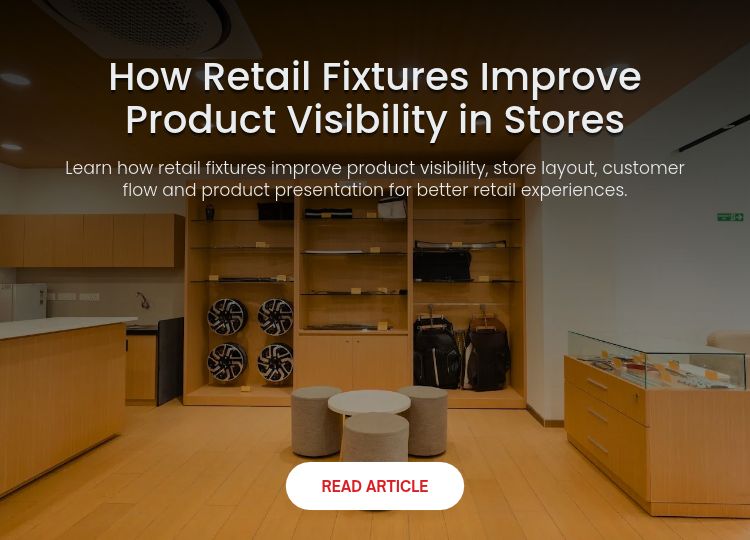
A retail fixture can influence product visibility in several ways. Its height, structure, placement, spacing and finish all affect how customers perceive the products displayed on it.
Let’s look at the most important factors.
1. Fixture Height Controls the Customer’s Line of Sight
The height of a retail fixture directly affects what customers see first.
Fixtures that are too tall can create visual barriers and block sightlines across the store. Customers may not be able to see products positioned behind them.
On the other hand, fixtures that are too low may not provide enough display space or visual impact.
The ideal height depends on the store format, product category and customer profile.
For example, a fashion store may use a combination of full-height displays, mid-height racks and lower tables. This creates different visual levels while keeping the store open and easy to navigate.
Consider different viewing levels
Retailers can use fixture height strategically:
- Eye-level: Important products, new launches and high-priority merchandise
- Mid-level: Core products and frequently purchased items
- Lower levels: Larger products, bulk merchandise or supporting inventory
- Higher levels: Branding, visual elements or lightweight products
A carefully planned combination helps create visual balance without making the store feel crowded.
2. Fixture Placement Creates Visual Focal Points
Where a fixture is placed can be just as important as how it looks.
Customers naturally notice certain areas of a store first. These can include the entrance, key sightlines, central displays and high-traffic zones.
Retailers can use strategically positioned fixtures to create focal points around important products.
For example, a central display table can highlight a new collection, while a branded wall fixture can showcase a particular product category.
Instead of placing every product display equally throughout the store, retailers can create clear areas of emphasis.
This helps customers understand where they should look first.
3. Open Fixtures Improve Sightlines
Open retail fixtures can make products easier to see from different parts of the store.
For example, open shelving or lower display units allow customers to see merchandise beyond the immediate display.
This can be especially useful in stores where customer movement and visual openness are important.
Closed cabinets, meanwhile, can be useful for premium, fragile or high-value products. However, excessive use of enclosed fixtures can reduce visibility and make the store feel more segmented.
Therefore, the right balance between open and closed displays is important.
4. Product Spacing Prevents Visual Clutter
More products do not always mean better visibility.
When too many products are placed on a single fixture, customers may struggle to understand what they are looking at.
This creates visual clutter.
A good retail fixture provides enough space between products to make individual items easy to identify.
Product spacing can help customers:
- See individual products clearly
- Compare different options
- Read product information
- Understand product categories
- Interact with merchandise comfortably
For retailers, this means fixture capacity should not be the only consideration. Display quality matters just as much as display quantity.
5. Fixture Design Supports Product Hierarchy
Not every product needs the same amount of attention.
Retail fixtures can help establish a clear hierarchy between different products.
For example, a retailer launching a premium product range might give those products:
- More display space
- Better lighting
- A dedicated fixture
- More prominent positioning
- Branded background elements
Meanwhile, supporting products can occupy secondary areas.
This creates a visual order that helps customers understand the range more quickly.
Create a clear visual hierarchy
A simple hierarchy might look like:
Primary product → Supporting product → Accessories → Promotional information
When fixtures support this hierarchy, customers can navigate product categories more naturally.
6. Lighting and Fixtures Work Together
A retail fixture does not work independently from the rest of the store environment.
Lighting can significantly influence how a product appears on a fixture.
For example, integrated LED lighting can help highlight:
- Product details
- Premium finishes
- Packaging
- Brand elements
- Feature products
- Promotional displays
Wall fixtures with integrated lighting can create strong focal points, while illuminated shelving can make selected products more noticeable.
However, lighting should support the fixture rather than overwhelm it.
The goal is to make the product stand out, not simply make the display brighter.
7. Fixtures Help Guide Customer Movement
Retail stores are designed around customer movement.
The arrangement of fixtures can influence where customers walk, where they stop and which products they encounter along the way.
For example, a retailer can use fixtures to create:
- Main walking paths
- Product zones
- Category sections
- Promotional areas
- Interaction points
- Checkout pathways
When customers move naturally through the store, they have more opportunities to discover products.
This is why fixture planning should happen alongside store layout planning rather than as an afterthought.
8. Fixtures Can Highlight New Products
New products need strong visibility, especially during launches.
A dedicated retail fixture can give a new product range its own visual identity.
Instead of placing new merchandise among existing products, retailers can create a dedicated display area using:
- Custom shelves
- Display tables
- Branded back panels
- Product stands
- Illuminated fixtures
- Promotional graphics
This gives customers a clear visual signal that something is new or different.
For brands operating across multiple stores, standardized fixtures can also help maintain consistent product presentation.
9. Custom Fixtures Can Solve Product-Specific Display Challenges
Standard fixtures may not always suit every product.
Different products have different requirements for dimensions, weight, interaction and presentation.
For example, electronics may require cable management and demonstration areas. Apparel requires hanging and folding solutions. Jewellery may require secure, premium display furniture.
Custom retail fixtures allow manufacturers and retailers to design around these requirements.
A custom fixture can consider:
- Product dimensions
- Weight requirements
- Storage needs
- Customer interaction
- Lighting
- Branding
- Security
- Material selection
- Installation requirements
This makes custom fixtures particularly useful for branded retail environments.
10. Fixtures Strengthen Brand Presentation
A retail fixture is also part of the physical expression of a brand.
Materials, finishes, colours, shapes and detailing can contribute to the overall store identity.
For example, a premium brand may use refined finishes and minimal display structures, while a high-volume retail format may prioritize accessibility, flexibility and efficient product presentation.
Consistent fixture design across locations can also help customers recognize a brand.
This becomes particularly important for businesses operating multiple stores across cities or regions.
Retail Fixtures for Different Store Formats
Different retail environments require different fixture strategies.
Fashion Retail
Fashion stores often use a combination of:
- Garment racks
- Wall displays
- Display tables
- Shelving
- Mannequin platforms
- Accessories displays
Fixtures need to support both product visibility and easy browsing.
Electronics Retail
Electronics stores typically need fixtures that allow customers to view and interact with products.
Display furniture may include:
- Demo counters
- Wall-mounted displays
- Product stands
- Secure cabinets
- Cable management systems
Here, fixture design must combine visibility with functionality and security.
Jewellery Retail
Jewellery fixtures often focus on premium presentation and controlled access.
Display counters and cabinets can provide:
- Clear product visibility
- Security
- Integrated lighting
- Premium finishes
- Organized product presentation
Automotive Showrooms
Automotive environments often use furniture and display fixtures to support both vehicle presentation and brand communication.
Fixtures may include:
- Customer consultation desks
- Product displays
- Accessory displays
- Brand walls
- Information counters
Grocery and Convenience Retail
Grocery stores depend heavily on shelving systems and product organization.
Fixture planning needs to consider:
- Product volume
- Category organization
- Customer movement
- Stock replenishment
- Shelf visibility
- Promotional displays
How to Choose the Right Retail Fixture
Choosing a retail fixture should begin with the product and customer rather than appearance alone.
Before selecting a fixture, consider the following questions.
What product will the fixture display?
Understand the product’s size, weight, packaging and presentation requirements.
How will customers interact with it?
Some products only need to be viewed. Others need to be touched, tested or compared.
Where will the fixture be placed?
Consider customer flow, sightlines and surrounding displays.
How much merchandise needs to be displayed?
The fixture should provide sufficient capacity without creating visual clutter.
Does the fixture need to support branding?
If the fixture is part of a branded retail environment, consider how logos, graphics, colours and materials will be incorporated.
Does it need lighting?
Some products benefit from integrated lighting, particularly premium merchandise and feature displays.
Will the fixture be used across multiple stores?
If yes, standardization, modularity and ease of installation become important considerations.
Common Retail Fixture Mistakes That Reduce Product Visibility
Even a high-quality fixture can perform poorly if it is used incorrectly.
Here are some common mistakes retailers should avoid.
Overcrowding the fixture
Trying to display too many products can make individual items difficult to notice.
Blocking important sightlines
Tall or poorly positioned fixtures can prevent customers from seeing key areas of the store.
Ignoring customer movement
A fixture that interrupts natural movement can negatively affect the shopping experience.
Using the same fixture everywhere
Different products and store zones may require different display solutions.
Neglecting maintenance
Damaged, dusty or poorly maintained fixtures can reduce the visual appeal of displayed products.
Focusing only on appearance
A fixture may look attractive but still fail if it does not support product accessibility, visibility or customer interaction.
Retail Fixture Planning: A Practical Checklist
Before finalizing your retail fixture design, review these points:
Product
- What product will be displayed?
- What are its dimensions?
- How many units need to be displayed?
Visibility
- Can customers see the product from key sightlines?
- Is the product at a comfortable viewing height?
- Is the display visually cluttered?
Customer Experience
- Can customers approach the fixture easily?
- Can they interact with the products?
- Does the fixture interfere with customer movement?
Branding
- Does the fixture match the brand identity?
- Is branding visible without overpowering the product?
Functionality
- Is the fixture durable?
- Is it easy to clean and maintain?
- Does it provide sufficient storage or display capacity?
Installation
- Can it be installed efficiently?
- Is it suitable for multiple store locations?
- Does it require specialized installation?
Why Retail Fixture Manufacturing Matters
Good fixture design needs to translate successfully from drawings into a finished physical product.
This is where the manufacturing process becomes important.
Material selection, fabrication, finishing, assembly and quality control can all influence the final appearance and performance of a retail fixture.
For businesses managing multiple stores, working with an experienced retail fixture manufacturer can also help maintain consistency across locations.
A manufacturing partner can support requirements such as:
- Custom furniture and fixtures
- Standardized store fixtures
- Large-scale production
- Material selection
- Metal and wood fabrication
- Finishing
- Assembly
- Packaging
- Installation support
For multi-location retail brands, this can make it easier to maintain consistent product presentation across stores.
The Future of Retail Fixture Design
Retail environments continue to evolve.
As brands experiment with smaller stores, experiential retail, digital displays and more flexible formats, fixtures are becoming increasingly adaptable.
Modern retail fixtures may combine traditional display furniture with:
- Digital screens
- Interactive displays
- Integrated lighting
- Modular components
- Flexible shelving
- Brand communication elements
This creates opportunities for retailers to make better use of available space while creating more engaging product presentations.
The goal, however, remains the same: make products easy to see, understand and access.
Final Thoughts: Why the Right Retail Fixture Matters
A retail fixture is more than a structure used to hold products. It influences how merchandise is seen, how customers move through a store and how the overall retail environment feels.
From fixture height and product spacing to placement, lighting and branding, every detail can affect product visibility.
The right fixture can help create clear sightlines, strong focal points and organized product displays. Meanwhile, poor fixture planning can lead to clutter, blocked views and a less effective shopping experience.
For retail owners and managers, the key is to treat fixtures as part of the overall store strategy rather than simply as furniture.
At VVT, we manufacture custom retail furniture and fixtures designed for branded retail environments, supported by large-scale manufacturing capabilities and experience across multiple retail sectors.
Planning a new store, showroom or retail rollout? Talk to our team to explore the right furniture and fixture solutions for your requirements.
FAQs
What is a retail fixture?
A retail fixture is a permanent or semi-permanent structure used to display, organize or support products in a retail store. Examples include shelving, display tables, racks, counters and custom display units.
How do retail fixtures improve product visibility?
Retail fixtures improve product visibility by controlling product height, spacing, positioning and presentation. Well-planned fixtures can create clear sightlines and highlight important products.
What are the most common types of retail fixtures?
Common types include shelving units, gondola displays, wall-mounted fixtures, display tables, product racks, cabinets, counters and custom retail display furniture.
How does fixture height affect product visibility?
Fixture height affects what customers see from different areas of the store. Excessively tall fixtures can block sightlines, while well-planned heights can create clear product visibility and visual hierarchy.
Should retail fixtures be customized?
Custom retail fixtures can be useful when products have specific display, storage, branding or interaction requirements. They are also helpful for brands that need consistent fixtures across multiple stores.
How can retailers avoid overcrowding fixtures?
Retailers can avoid overcrowding by balancing product quantity with available display space, maintaining adequate product spacing and using different fixture types for different product categories.
What should retailers consider when selecting a fixture manufacturer?
Retailers should consider manufacturing capabilities, material expertise, production capacity, quality control, customization, finishing, installation capabilities and experience with retail environments.